
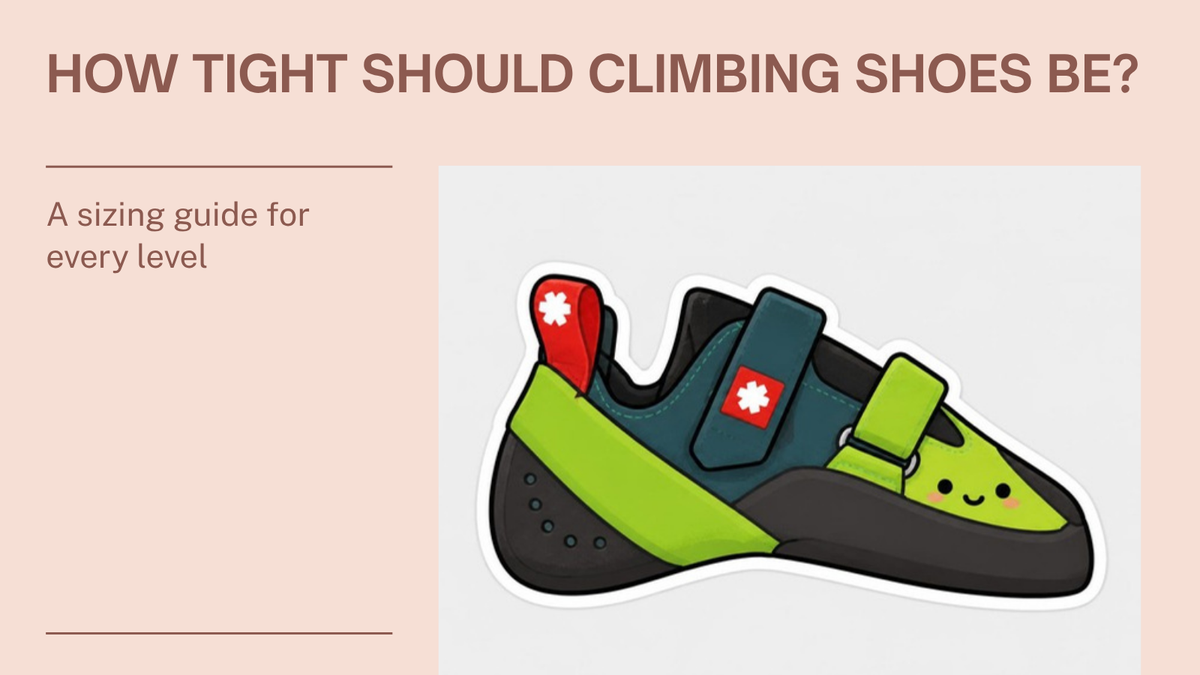
If you've ever stood in a climbing shop with one shoe on, wondering whether the pinching in your toes is "good tight" or "I'll regret this" tight, you're not alone. Sizing is the single most common question we get about climbing shoes, and the honest answer is: it depends on you, the shoe, and what you're climbing.
Here's how to work it out.
The short answer
Climbing shoes should fit snug all over with no dead space, but they should never be painful enough to stop you climbing. Your toes should sit flat or slightly bent at the end of the shoe, your heel should be held firmly with no gap, and you shouldn't have any sharp pressure points.
If you're new to climbing, the goal is comfortably firm. If you're chasing harder grades on steep terrain, you'll usually go tighter. Nobody needs to suffer to climb well.
| Your level | What the fit should feel like | Shoe shape to look at |
|---|---|---|
| Beginner | Toes flat or barely curled, heel secure, comfortable for a full session | Neutral, all-rounder |
| Intermediate | Snug all over, toes lightly curled, no hot spots | Neutral to moderate |
| Advanced | Firm and precise, toes curled in a downturned shoe, tolerable for a hard session | Moderate to aggressive |
How tight should beginner climbing shoes be?
When you're starting out, your footwork and technique matter far more than squeezing into a tiny shoe. Beginners should aim for:
- Toes touching the end of the shoe, lying flat or only very slightly curled
- A secure heel with no air gap or lifting when you pull on the shoe
- No pain, numbness or toes folded under
- A shoe you could comfortably wear for a full indoor session
A flat, neutral shoe sized for comfort lets you learn to stand on small holds without fighting your own footwear. You can always size down or move to a more aggressive shoe later as your skills develop. Browse our beginner essentials or all-rounder climbing shoes to see good places to start.
How tight should intermediate and advanced climbing shoes be?
As you climb steeper and harder, a tighter fit helps you transfer power through your toes and keep your foot locked in on overhanging terrain. Experienced climbers often choose a shoe where the toes are slightly curled or the arch of the foot is pulled in by a downturned shape.
That said, tighter is not automatically better. If your shoes are so tight that you can't trust your feet, or you're taking them off between every attempt, you're likely losing performance rather than gaining it. Many strong climbers keep a comfortable, all-day pair for volume and mileage and a tighter pair for hard sessions or projects.
If you're after a more precise, downturned shoe, check out our aggressive performance climbing shoes.
Match the fit to the shoe shape
How tight is right also depends on how the shoe is built:
- Neutral (flat) shoes: Comfort-focused and forgiving. Great for beginners, long routes and all-day wear.
- Moderate shoes: A slight downturn adds precision on technical terrain while staying wearable.
- Aggressive (downturned) shoes: Designed to pull your toes into a powerful curve for steep climbing. These are meant to feel snugger and are usually not the best pick for a first pair.
You can also sit between sizes depending on the closure. Velcro makes it easy to adjust on the fly, laces let you fine-tune the fit across the foot, and slippers are stretchy and sensitive but rely on a good all-round fit.
Will climbing shoes stretch?
Often a little. Unlined leather uppers tend to stretch the most over the first few sessions, while lined leather and synthetic uppers stretch much less. Because of this, a shoe made of stretchy material can feel noticeably tighter in the shop than it will after a week or two of use.
The catch is that you can't count on it. If a shoe is painfully tight right out of the box, don't assume it will break in. Fit comes first, stretch is a bonus.
A quick at-home fit check
Whether you're trying shoes in person or at home, run through this list:
- Stand up and wiggle. Your toes should feel supported but not crushed.
- Check the heel. It should feel cupped and secure. If you can lift it out of the shoe easily, go smaller or try a different model.
- Look for dead space. Air pockets on top of the foot or around the toe box mean the shoe is too big or the wrong shape for your foot.
- Rock onto your toes. You should be able to stand on a small edge without your foot swimming around.
- Wear them for a few minutes. Hot spots usually show up quickly.
Common sizing mistakes
- Sizing to your street shoe. Climbing shoe sizing is different, and it varies between brands and even between models from the same brand.
- Going too small too early. A painful shoe changes how you climb and makes you want to stop. Build up gradually.
- Ignoring foot shape. Some shoes suit wide feet, some suit narrow feet, and some are low-volume. A great size in the wrong shape is still a bad fit.
- Buying on looks. A shoe that suits your friend's foot may not suit yours.
Shoes to try, from comfy to aggressive
A few places to start, from an all-rounder through to a more aggressive shoe:


Not sure what size to get?
Sizing climbing shoes online can feel like a gamble, and that's exactly why we're happy to help. Message us with your usual shoe size, what kind of climbing you do and any shoes you've worn before, and we'll point you to the right model and size. You can browse all our climbing shoes here.
Happy climbing,
Mitch & Sophie
Co-founders of Happy Biner

Leave a comment
This site is protected by hCaptcha and the hCaptcha Privacy Policy and Terms of Service apply.