
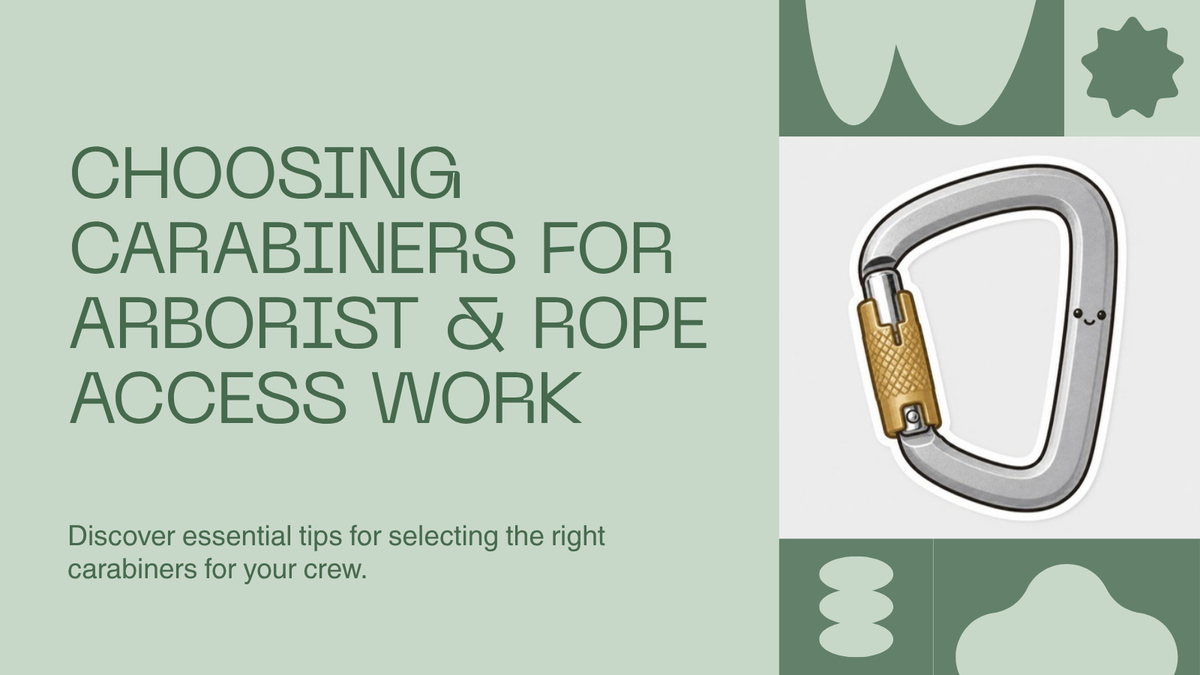
Carabiners are the small pieces of hardware that hold a lot of responsibility. For arborists, rope access technicians and anyone working at height, choosing the right connector affects safety, efficiency and how long your kit lasts.
This guide explains what to look for so you can choose carabiners that suit the job, the system and your workplace requirements.
Please note: This is general product information, not a substitute for training, your employer's procedures, a safe work method statement or advice from a competent person. Always follow the manufacturer's instructions and the requirements that apply to your work.
1. Steel vs aluminium carabiners
The first decision is usually the material.
- Aluminium: Lighter and easier to carry in large numbers. A popular choice where weight matters, such as for a full day of tree work or a long rope access shift.
- Steel: Heavier, but more resistant to wear and abrasion. Steel is common in high-use positions such as anchors, connections that see a lot of rope movement, and for teams working with ropes and devices every day.
Many professionals carry a mix, using steel where durability matters most and aluminium where weight savings add up.
2. Gate type and locking mechanism
Locking carabiners are standard for work at height. The main options are:
- Screwgate: A simple, reliable manual lock that's easy to inspect and widely used. It does need to be fully closed every time.
- Twist-lock (auto-locking): The gate locks automatically when released, and you twist to open. Quicker to use, and less likely to be left unlocked by mistake.
- Triple-action (and similar multi-action locks): Needs more than one deliberate action to open. Often chosen where accidental opening needs to be reduced as far as possible, such as when attaching to a harness.
Whichever type you use, check the gate opens, closes and locks smoothly before every use.
Material and gate type at a glance
| Choice | Good for | Keep in mind |
|---|---|---|
| Aluminium | Lighter carry, long days, spare connectors | Wears faster in high-friction positions |
| Steel | Durability, high-use anchors and rope contact points | Heavier |
| Screwgate | Simple, reliable, easy to inspect | Must be fully screwed closed each time |
| Twist-lock | Fast operation, locks automatically | Check it fully locks every time |
| Triple-action | Reducing accidental opening | Slightly slower to operate, especially in gloves |
3. Shape: HMS, D, oval and offset D
- HMS (pear-shaped): Wide at the top and ideal for use with friction hitches, descenders and ropes. A common all-rounder.
- D-shaped: Loads sit along the strongest part of the carabiner (the spine). Often used for strength and compact size.
- Oval: Symmetrical and good for pulleys and consistent loading, though they don't have the strength benefits of a D.
- Offset D: A larger gate opening than a standard D, making clipping and gear handling easier.
Larger gate openings can be easier to work with, especially in gloves. Check that the carabiner suits the device, rope and hardware you plan to connect to it.
4. Strength ratings and markings
Look at the markings stamped on the carabiner. Typically you'll find:
- Strength ratings in kN: Often shown for the major axis (along the spine), the minor axis (across it) and with the gate open. A carabiner is much weaker across the minor axis or with the gate open, so loading it correctly is critical.
- Standard markings: Such as EN 362 for connectors used in personal protective equipment against falls from height, and EN 12275 for climbing carabiners. Which marking you need depends on the application, so check what your workplace or industry requires. In Australia, industrial fall-arrest equipment is also covered by the AS/NZS 1891 series.
- Manufacturer and batch information: Useful for traceability and keeping a gear register.
If you're unsure which standard applies to your work, check with your employer, your industry body or a qualified safety professional before buying.
5. Think about how you'll load it
A few factors help narrow down the choice:
- What are you connecting? A harness attachment point, a rope-to-device connection and an anchor point all have different demands.
- Will you wear gloves? Easier-to-operate locks and bigger gates matter.
- Will it be loaded across the wrong axis? Choose shapes and set-ups that keep loading in line with the spine.
- How often will it be used? High-use carabiners wear faster, and may be better in steel.
6. Inspect and retire carabiners properly
Before each use, check for:
- A gate that sticks, is bent, or doesn't close or lock fully
- Cracks, deformation or corrosion
- Deep grooves or sharp burrs from rope wear
- Dirt or grit in the locking mechanism
- Any impact or drop that could have caused damage you can't see
Work equipment should also be inspected on a regular schedule in line with the manufacturer's instructions and your workplace procedures. If in doubt, take it out of service.
Buying for a crew or a business?
If you're kitting out a team, replacing worn hardware or standardising gear across a business, get in touch. We can talk through your application and point you to suitable products. A few popular options from our industrial range:


Browse our industrial carabiners, the full arborist range and the wider industrial collection, including ascenders and descenders.
Work safe,
Mitch & Sophie
Co-founders of Happy Biner

Leave a comment
This site is protected by hCaptcha and the hCaptcha Privacy Policy and Terms of Service apply.